What is an AI shopping assistant?
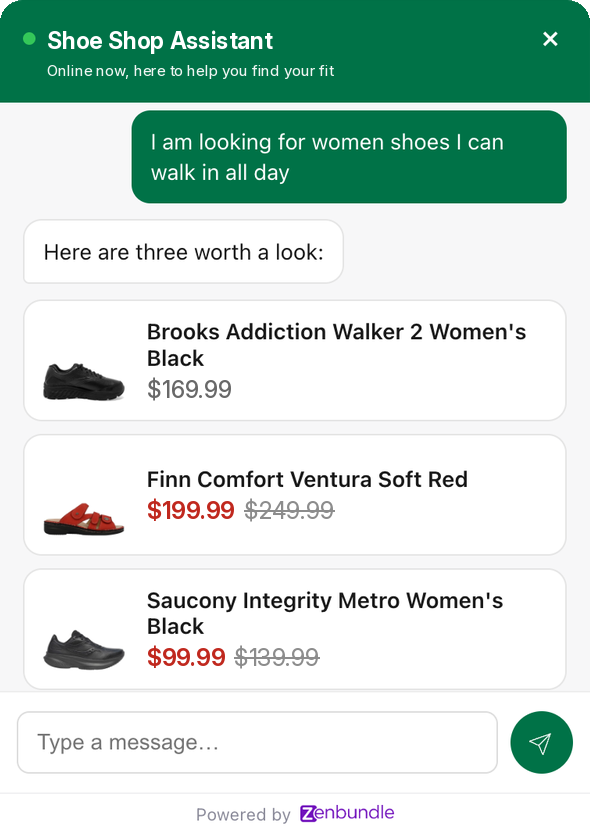
A shopper-facing assistant that sits on your storefront and answers questions in plain language, the way a good salesperson would. Unlike a search box it can take a whole question at once, such as "cushioned road shoe for marathon training, size 9". Unlike a scripted chatbot it is not limited to a decision tree. Zenbundle AI Chat answers only from your live catalogue, your real stock and your published policies.
How much does Zenbundle AI Chat cost?
Two plans, priced by the size of your store rather than by chats. Both include unlimited chats and order lookups. Standard is $199 a month for stores doing up to 500 online orders a month. Pro is $299 a month for stores doing up to 2,500 online orders a month, and adds a monthly conversation report and an onboarding call. Both are billed through Shopify with no lock-in and are listed on the Shopify App Store listing. Above 2,500 online orders a month, or if you want the assistant built around your business (size translation across brands, your in-store service level, a contracted SLA), that is the Enterprise plan, agreed on a setup call.
Is there a free trial?
Not right now. Three days is not long enough for a shoe store to see it answer real customers, so instead the first 25 footwear stores get a $199 launch credit: a full first month, credited back to your account once Shopify has paid us for it. Use it for a month and cancel if it is not for you; you still get the credit.
How does the $199 launch credit work?
Register on this page before you install, or within 24 hours of installing. Install the Footwear app and approve the monthly charge for your plan. Once Shopify pays us for your first month, usually within 30 days of your Shopify bill, we apply a $199 credit to your Zenbundle account. One credit per store, 25 places, and the offer closes on 15 October 2026 or when the places are gone, whichever comes first.
Do AI shopping assistants give accurate information?
Not all of them. Most are a general language model with a store's logo on it, so they can invent a product, a size, a price or a returns policy. Zenbundle AI Chat can only speak from what it reads in your live Shopify catalogue and your own policy pages. If the thing does not exist it says so, and offers the nearest thing that does. Across the measured window 96.7% of its replies were delivered clean, counting both hard errors and empty replies as failures.
How do I add an AI shopping assistant to my Shopify store?
Footwear stores install Zenbundle AI Chat: Footwear from the Shopify App Store. It reads your catalogue, you set the greeting, tone and colours, and you switch it on. Most stores are live in minutes; free onboarding help is there if you want it. Growth plan stores in any vertical get it set up and run by our team, live in 24 hours. See how we work.
My store isn't footwear. When is my vertical coming?
Dedicated apps for pharmacy and health, beauty, electrical and appliances, sports and outdoor, fashion, baby and kids, home and garden, pets, and toys are coming online over the coming months, in the order stores ask for them. Register your vertical and we will tell you the day yours is live. The same engine is already live for Growth plan stores in pharmacy, electrical and sports retail today.
How is this different from a generic Shopify AI chatbot?
Two things. It is grounded, so it answers from your live catalogue and policies rather than from general knowledge. And it is tuned per category: footwear gets fit and width, pharmacy gets clinical suppression and a hand-off to the pharmacist, electrical gets spec discipline.